


Latest News
Blog
Economic Health Check: Understanding Jobs, Inflation, and Growth

February 18, 2026

For clients, the state of the economy matters significantly because it influences both portfolio performance and financial planning outcomes. Recent economic indicators have delivered conflicting messages, creating uncertainty about the current landscape.
Much like medical professionals don’t rely on a single metric to assess patient health, investors shouldn’t base their outlook on isolated data points. Just as blood pressure and heart rate each reveal different aspects of physical wellness—and what’s considered normal varies by individual—economic indicators like employment figures, inflation rates, and GDP collectively paint a complete picture. These metrics fluctuate throughout business cycles, yet various economic conditions can still support investment objectives and financial goals.
Current headline figures appear generally positive: economic expansion exceeds forecasts, price pressures are moderating, and joblessness stays historically low. Yet employment trends reveal greater complexity. Though the most recent monthly data looked promising, job creation over the past year proved significantly weaker than initial estimates suggested. For those investing with a long-term perspective, what matters most is comprehending how individual data points interconnect to form a comprehensive view, rather than overreacting to isolated reports.
Employment trends have reached a turning point
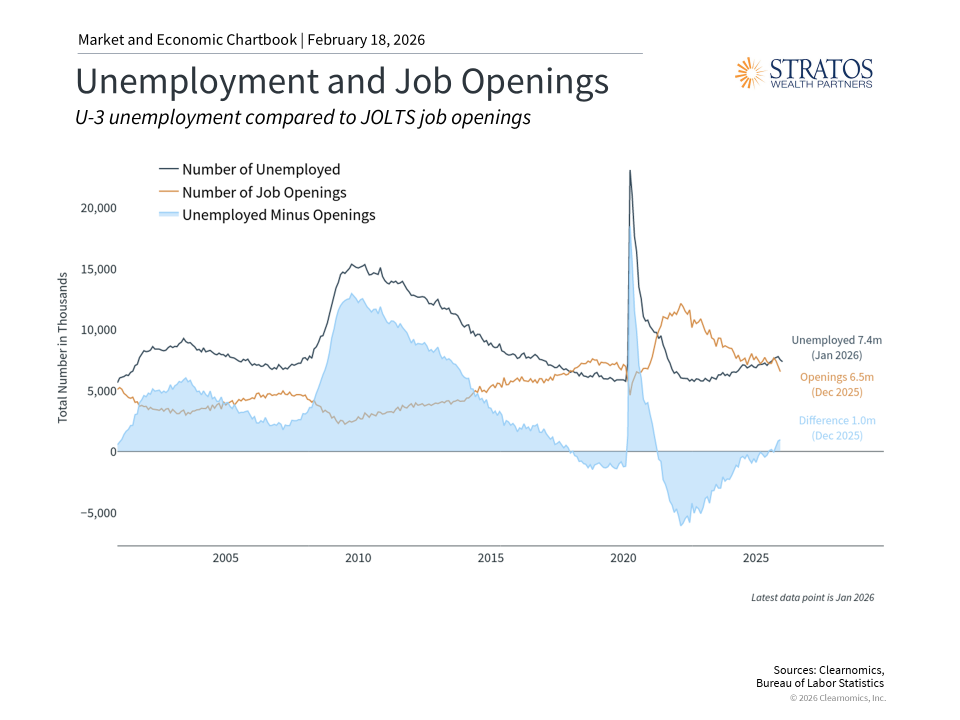
Interpreting labor market conditions has proven difficult in recent months due to government shutdowns that postponed data releases, adverse weather conditions, and other disruptions. For workers, the most significant change involves the relationship between available positions and those seeking employment.
The chart above illustrates how the post-pandemic era saw several years where job openings exceeded the number of unemployed people. This ratio stayed above one from mid-2021 through last summer, peaking at two available positions for every job seeker in 2022. Currently, approximately 7.4 million Americans are unemployed while only 6.5 million job openings exist, representing the smallest number of unfilled positions since late 2020.
Nevertheless, January’s employment report delivered encouraging results, revealing the economy created 130,000 positions that month, almost twice economists’ projections. These gains concentrated primarily in health care, social assistance, and construction industries. The jobless rate decreased to 4.3% from 4.4% and continues hovering near historically low territory. Viewed in isolation, this might indicate labor market momentum is building.
Though these figures look favorable, the underlying trend has been more difficult. The Bureau of Labor Statistics released their annual benchmark revisions using more comprehensive data than what was initially available for each monthly release. These revisions revealed that job creation throughout 2025 totaled just 181,000, averaging approximately 15,000 monthly, marking the weakest annual performance since 2020. For perspective, robust employment growth typically measures in the millions annually, before these adjustments.
How has the overall jobless rate remained relatively stable despite weaker hiring activity? Demographics and immigration patterns provide part of the explanation. The Census Bureau recently documented a substantial drop in net international migration, declining from roughly 2.7 million in 2024 to approximately 1.3 million in 2025, with additional decreases anticipated. Furthermore, population aging and reduced workforce participation translate to fewer individuals joining the labor pool. In essence, both supply and demand dynamics within the employment market are moderating, helping prevent unemployment from climbing higher.
Employment, prices, and overall economic performance
The labor market draws significant investor attention because it offers concrete insights that many other economic measures don’t. Employment conditions directly influence household earnings, consumer sentiment, and purchasing behavior. Since consumer expenditures represent more than two-thirds of U.S. GDP, developments in the job market ultimately impact broader economic activity.
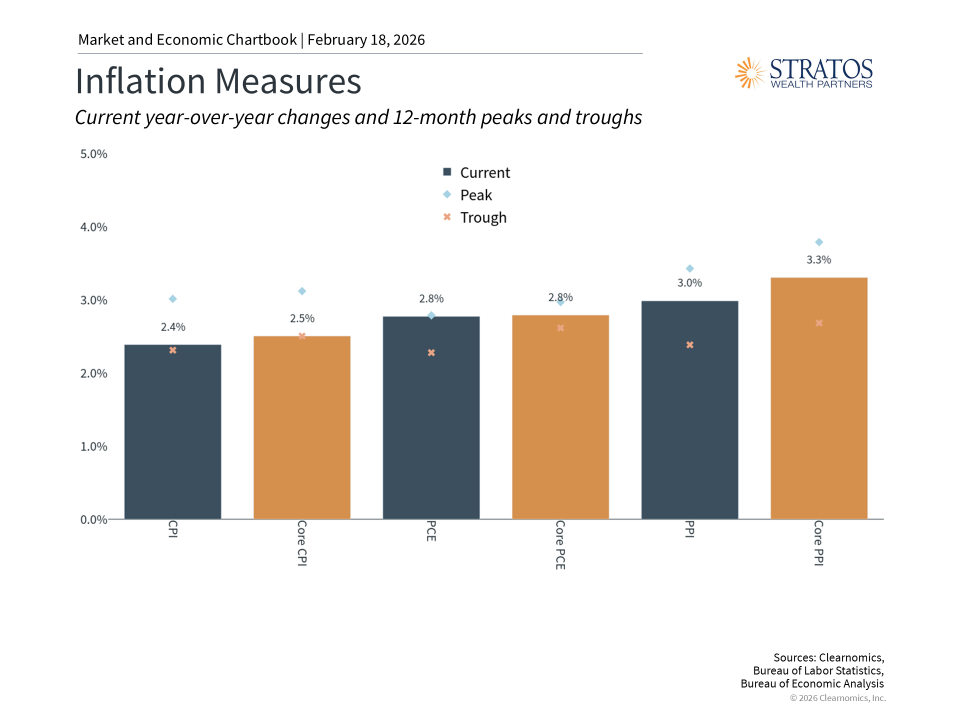
Yet employment represents just one piece of the puzzle. Additional indicators, particularly inflation metrics, suggest reasons for optimism. Until recently, rising prices posed the greatest challenge for both investors and policymakers. Recent figures show the Consumer Price Index increased merely 2.4% year-over-year, while core inflation, excluding food and energy components, slowed to 2.5%, reaching the lowest level in almost five years. One “supercore” inflation gauge, which also strips out shelter costs, climbed only 2.1% over the preceding twelve months.
This consistent moderation moves the Fed nearer to its 2% objective and indicates inflationary forces continue subsiding. Naturally, elevated prices still burden many households and retirees because slower inflation doesn’t reverse previous price increases. Nonetheless, the containment of price pressures benefits both the economy and investment portfolios, as inflation can negatively impact both equities and fixed income.
Portfolio implications of the current economic landscape
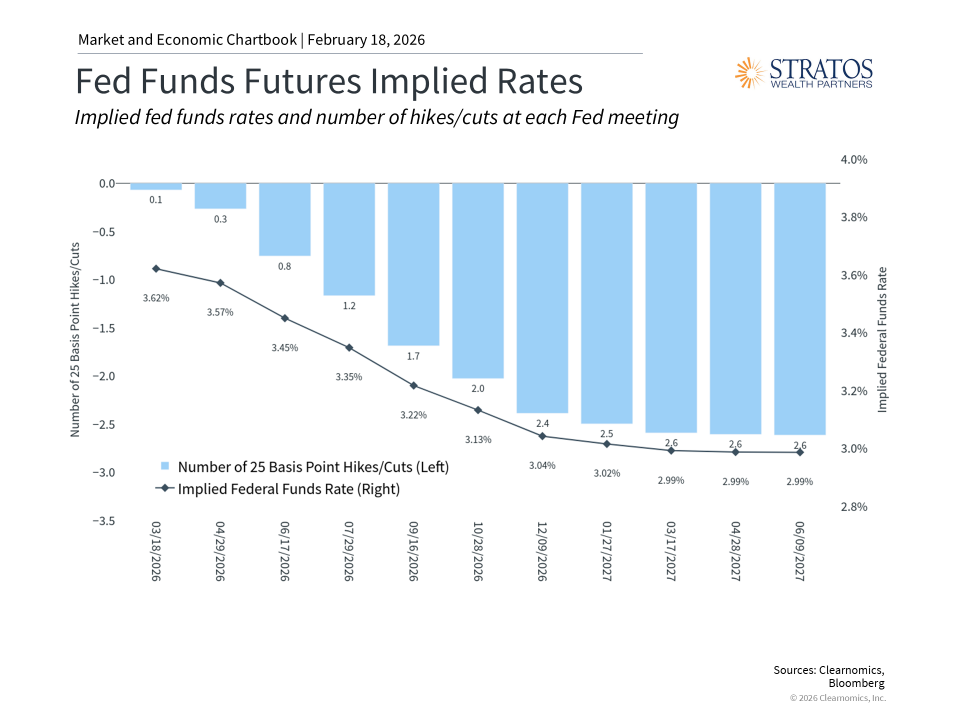
From an investment perspective, today’s economic backdrop appears cautiously favorable. The mix of consistent expansion, moderating inflation, and easing labor conditions can produce a balanced environment that avoids extremes. This scenario can support both equity and bond markets, particularly if it contributes to maintaining low borrowing costs. Markets have responded to recent employment and inflation releases with declining interest rates throughout the yield curve, as the 10-year Treasury yield holds just above 4%.
These reports also shape Federal Reserve expectations and enhance the probability of policy adjustments later this year. Currently, market-derived indicators suggest at least two rate reductions this year, with the potential appointment of a new Fed chair by President Trump adding to this likelihood.
Should rates continue declining, portfolios benefit through reduced business borrowing expenses and enhanced present value of future corporate profits. Outstanding bonds also typically appreciate when rates fall. Even without further rate decreases, bonds continue delivering appealing yields and can provide stability for long-term investors. Meanwhile, corporate profit growth persists, representing one of the key drivers supporting broader market performance over the past year.
The bottom line? Employment conditions are moderating while the overall economy maintains its health. For clients, this nuanced environment favors a balanced strategy and underscores the value of maintaining a long-term perspective regarding portfolios and financial planning.
Taylor Salisbury is a registered representative with, and securities offered through LPL Financial, member FINRA/SIPC. Investment advice offered through Stratos Wealth Partners, Ltd., a registered investment advisor. Stratos Wealth Partners, Ltd. is a separate entity from LPL Financial.
Trading instructions sent via email, fax, or voicemail will not be honored. There is no assurance that these messages can be retrieved on a timely basis, nor is there any sure method of confirming the customer identity. The information contained in this message is being transmitted to and is intended for the use of only the individual(s) to whom it is addressed. If the reader of this message is not the intended recipient, you are hereby advised that any dissemination, distribution or copying of this message is strictly prohibited. If you have received this message in error, please immediately delete.
Copyright (c) 2026 Clearnomics, Inc. All rights reserved. The information contained herein has been obtained from sources believed to be reliable, but is not necessarily complete and its accuracy cannot be guaranteed. No representation or warranty, express or implied, is made as to the fairness, accuracy, completeness, or correctness of the information and opinions contained herein. The views and the other information provided are subject to change without notice. All reports posted on or via www.clearnomics.com or any affiliated websites, applications, or services are issued without regard to the specific investment objectives, financial situation, or particular needs of any specific recipient and are not to be construed as a solicitation or an offer to buy or sell any securities or related financial instruments. Past performance is not necessarily a guide to future results. Company fundamentals and earnings may be mentioned occasionally, but should not be construed as a recommendation to buy, sell, or hold the company’s stock. Predictions, forecasts, and estimates for any and all markets should not be construed as recommendations to buy, sell, or hold any security–including mutual funds, futures contracts, and exchange traded funds, or any similar instruments. The text, images, and other materials contained or displayed in this report are proprietary to Clearnomics, Inc. and constitute valuable intellectual property. All unauthorized reproduction or other use of material from Clearnomics, Inc. shall be deemed willful infringement(s) of this copyright and other proprietary and intellectual property rights, including but not limited to, rights of privacy. Clearnomics, Inc. expressly reserves all rights in connection with its intellectual property, including without limitation the right to block the transfer of its products and services and/or to track usage thereof, through electronic tracking technology, and all other lawful means, now known or hereafter devised. Clearnomics, Inc. reserves the right, without further notice, to pursue to the fullest extent allowed by the law any and all criminal and civil remedies for the violation of its rights.
Tracking ID: 1066380